The Windowpane: From Glassmaking to a View
The windowpane shows how clearer, larger glass changed a wall from a barrier into a view, and why glare, distortion and size still shape what we see.
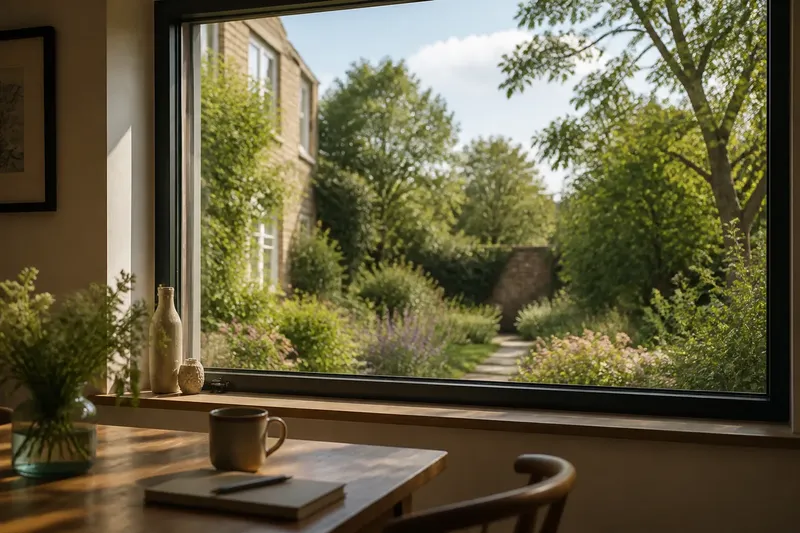
A small pane can turn a bright room into a patchwork of reflections; a broad, clear one makes the garden beyond feel close enough to join the room. The windowpane’s history is not simply a story of glass becoming better. As glassmakers learned to make panes clearer and larger, windows changed from light openings into places to look through—and that shift brought new design problems with it.
Those problems are familiar: a view that seems wavy, a window that catches the sky instead of showing the street, or a large expanse of glazing that feels less like an opening than a blank wall. Each has a material cause as well as a design one. Understanding how pane-making changed helps explain what a window can offer, and what it cannot.
Why did early panes break the view into pieces?
For much of glassmaking history, producing a large, flat, consistently clear sheet was difficult. A window could instead be assembled from small pieces, held in a framework of lead or another supporting material. The framework did more than hold glass in place: it divided the opening into a pattern of little views.
Small panes suited the limits of the material and the process. They also made a damaged section easier to replace without dismantling the whole window. But the view came through a grid. Looking out meant looking across a succession of panes and joints, each with its own reflections, marks and slight variations.
Glass was also not equally transparent in every pane. Bubbles, ripples and uneven thickness could bend light, so a straight edge outside might appear to waver. The effect was not necessarily a defect in the window’s purpose. At a time when glassmaking could not readily produce broad, uniform sheets, a modest opening that admitted daylight was already useful.
What changed when glassmakers made larger sheets?
Different forming methods made different kinds of window glass. In one traditional approach, a glassmaker spun molten glass into a broad disc, then cut pieces from it. The centre and outer parts of the disc could differ in appearance and thickness. Another method formed a cylinder of glass, which was cut open and flattened into a sheet. These processes could yield larger pieces than a small-paned assembly, but neither automatically produced perfectly flat, clear glass.
Later methods made it increasingly practical to form broad sheets with more consistent surfaces. The change mattered because a pane could now occupy more of an opening without a dense network of supporting divisions. A window began to offer a continuous field of vision, not just a set of framed glimpses.
That continuity altered the feeling of a room. A wall with a window had long admitted daylight, but a broad pane also made the outside legible as a scene. Trees, paths and neighbouring buildings could be read together rather than in fragments. The window became an instrument of looking, and its size and placement became deliberate parts of interior design.
Why can a clear pane still distort the view?
“Clear” describes how much light passes through, not whether every ray travels without alteration. A pane may look transparent while still bending a reflected line or making an object seem subtly displaced. Uneven thickness, surface irregularities and the angle of view can all contribute.
Older panes often show more visible waviness than modern flat glass, but age alone does not explain every distortion. A reflection can ripple because the glass surface is uneven; a view can appear shifted because the pane is angled or because two surfaces reflect light back and forth. At night, indoor lights may become more prominent than the scene outside, even through a flawless pane.
Try to identify the source before deciding that the glass is poor. Look at a straight vertical edge outdoors, such as a door frame, from several positions. If its apparent bend changes as you move, the pane or viewing angle may be involved. If the view is sharp in daylight but disappears after dark, reflections are likely doing more than the pane itself.
Why does a bigger window not always give a better view?
A larger pane reduces the visual interruption of frames, but it also makes the glass itself more present. A broad surface can reflect a bright sky, a lamp or a pale wall across much of the opening. Instead of seeing through the wall, you may see the room laid over the landscape.
Size also changes the relationship between the viewer and the opening. A low sill can make a seated view feel connected to the ground outside; a high sill may frame treetops and sky. A narrow window can isolate a particular feature, while a broad one gives the eye more to sort through. More glass is not automatically more useful: the best opening depends on what is meant to be seen from the places where people actually sit, stand or pass.
Imagine a small dining room with a broad window facing a pale neighbouring wall. If the glass reflects a pendant lamp and the wall dominates the view, shifting the table so the main sightline meets the garden rather than the boundary may make the opening more engaging without changing the pane. The observable result to look for is a view that holds the eye beyond the glass, rather than a reflection of the room.
How can you tell whether the problem is glass, glare or framing?
Change one viewing condition at a time. This keeps a design decision from being mistaken for a material fault.
- Check the light. Compare the view when the room is bright and when indoor lights are off. A strong reflection that recedes as the interior darkens points to reflected light.
- Move your viewpoint. Look from the usual chair, then from a step to one side. A view that opens up from a different position may be constrained by framing, furniture or the angle of the pane.
- Find a straight reference. Use an outdoor door frame, fence post or building edge. A visibly wavering line can suggest uneven glass, particularly in an older pane.
- Inspect the divisions. Notice whether muntins or heavy frames cut through the feature you want to see. The obstruction may be the window’s layout rather than its transparency.
- Consider the scene beyond. A pane cannot make a close wall feel distant. If the view is dominated by a nearby boundary, changing what is framed or where you look may matter more than changing the glass.
If the glass is cracked, loose or part of a window with a specialised finish, avoid treating appearance as the only concern. The right choice depends on the pane’s label, the manufacturer’s instructions and local rules; ask a qualified glazier where replacement or safety is in question.
What can you adjust before replacing a pane?
Start with the things around the glass. A curtain pulled partly across the opening, a lamp opposite the pane or a glossy surface near it can add competing reflections. Moving a lamp away from the sightline or choosing a less reflective window treatment may make the outside more readable. Try the adjustment at the time of day when the view matters most.
Next, consider framing. A deep frame or a prominent grid can make a pane feel smaller than it is. If the window is being redesigned, compare the view from the room rather than judging a sample frame on its own. Ask where the divisions will fall against the outside scene and whether they interrupt a horizon, doorway or garden feature.
For a wavering old pane, decide whether the distortion is a nuisance or part of the window’s character. Replacing it with flatter glass may sharpen the view, but it can also change the way the opening relates to the rest of the building. If the window is historic or has unusual construction, get advice from a conservation-minded glazier before altering it.
Which windowpane questions come up most often?
Why do old windows look wavy?
Older forming methods could leave glass with uneven thickness or a gently irregular surface, which bends light and makes straight lines seem to ripple. A changing reflection can create a similar impression, so check the pane in daylight from more than one position.
Does thicker glass always give a clearer view?
Thickness alone does not determine visual clarity. Surface flatness, the glass construction and the angle of observation also matter, so choose a pane for its intended use and specifications rather than assuming that more material means a truer view.
Why do I see the room in the window at night?
When the interior is brighter than the scene outside, light from lamps and lit surfaces reflects back from the glass and becomes easier to see. Turning off nearby lights or adjusting their position can reduce the competing reflection.
Can a window be too large for its room?
It can feel oversized if glare, the view’s composition or the room’s arrangement makes the pane dominate. Consider the intended sightline, the location of furniture and how reflections behave before deciding that more glass will improve the room.
What does the pane contribute to the experience of a wall?
The windowpane is both a material surface and a design boundary. Its clarity affects how directly a scene reaches the eye; its size affects how much of that scene appears together; its divisions decide whether the view feels continuous or parcelled out. Glassmaking expanded those choices, but it did not make every opening equally successful.
When judging a windowpane, begin with the view you want from a particular spot, then separate distortion, reflection and framing. That small distinction is useful whether you are living with rippled glass or planning a new opening. The history of clearer, larger panes points to a practical lesson: a window is not simply a hole filled with glass, but a carefully placed way of seeing through a wall.