Woven or Knitted Fabric: How Structure Shapes Stretch and Surface
Woven or knitted fabric differs at the thread level; learn how crossings and loops shape stretch, surface and form so you can choose fabric with confidence.
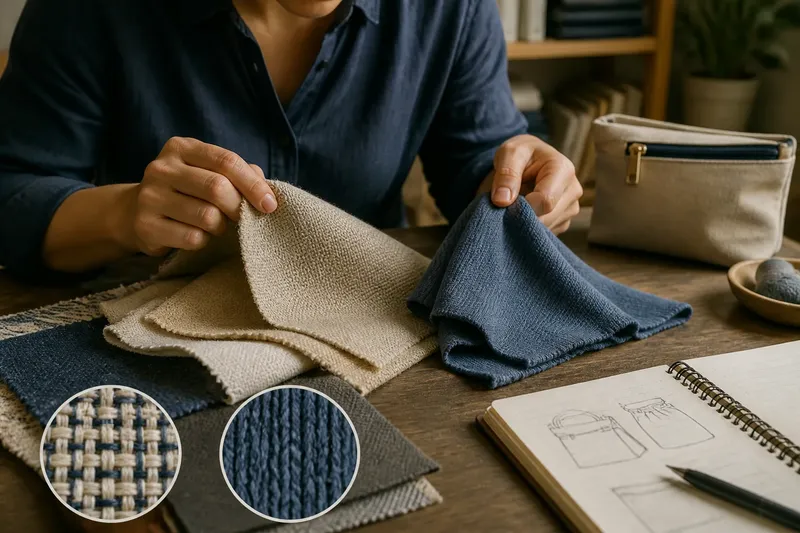
Woven or knitted fabric can look similar on a shop shelf, but its thread structure changes how it stretches, drapes and holds an edge. To tell what you are handling, look for crossings or loops first, then connect that structure to the shape the cloth needs to make.
What changes when yarns cross or loop?
Woven cloth is made by interlacing two sets of yarns. The lengthwise yarns, called the warp, run along the fabric; the crosswise yarns, called the weft, pass over and under them. In a plain weave, each yarn alternates over and under its neighbours. Other weaves change that pattern, but the basic structure remains a grid of crossings.
Knitted cloth is formed from yarn arranged in connected loops. A row of loops links with the row beside or below it, so the fabric can flex as those loops change shape. The yarn is not simply crossing another yarn; it bends and interlocks with itself or with adjacent loops.
That distinction is useful even when a surface is brushed, printed or tightly finished. Examine a raw edge, the inside of a garment, or a small section under a bright lamp. Woven cloth usually shows straight yarns meeting at right angles, while knitted cloth reveals a chain or column of loops.
How does structure affect stretch and form?
A woven fabric often resists stretching along its length and width because the yarns have to shift at their crossings before the cloth can extend. It may still give on the diagonal, known as the bias, where the grid can tilt. Some woven fabrics also include elastane or use a loose weave, so structure is a guide rather than a promise of stiffness.
Knitted fabric usually stretches more readily because its loops can open, narrow or lean without the yarn itself needing to stretch by the same amount. A fine jersey T-shirt can extend across the body, while a rib knit has pronounced columns that open and recover as it is pulled. The type of knit and the yarn both affect the result.
These differences influence form. Woven cloth often makes a crisp fold, defined pleat or stable panel. Knits tend to follow curves and sit close to the body, though a heavy or tightly constructed knit can hold a shape of its own. Neither structure is inherently better: the useful question is whether the fabric’s movement suits the object.
What do the surface and edges tell you?
Look at how the surface catches light and how the edge behaves. A woven surface may show a small, regular pattern of crossings; twill, for instance, forms diagonal lines. A knit often shows rows of tiny V shapes on its face, with bumps or loops on the reverse. Brushing, pile and print can obscure these clues, so check more than one spot.
Edges offer another practical signal. Cut woven cloth can fray as loose yarn ends escape from the crossings. A knit may curl at a cut edge, ladder if a loop is pulled free, or remain stable if its construction and finish resist those effects. For a garment or soft furnishing, inspect the seam allowance and finished edge rather than judging only the front.
Surface texture also affects how a material reads. A smooth woven poplin can look neat and crisp; a looped knit can appear soft or textured. Yet yarn choice and finishing matter too: wool, cotton and synthetic fibres can each be woven or knitted, and the same fibre can feel quite different in different constructions.
How should you choose fabric for a particular form?
Start with the shape and movement you want, then consider the structure. A shirt with a sharp collar may benefit from a stable woven cloth. A close-fitting top may need the give of a knit. A bag panel that should stay flat could suit a firm woven fabric, while a soft hat may take advantage of knitted stretch.
- For a crisp outline: try a stable woven fabric and check how it behaves on the bias.
- For a close fit: look for a knit with comfortable extension in the direction the garment needs to move.
- For a clean cut edge: consider whether the material frays, curls or runs, then choose a suitable finish.
- For a textured surface: inspect the yarn structure as well as any brushing, ribbing or raised finish.
- For a seam that must hold its shape: check how the fabric responds to handling and whether the seam needs stabilising.
Labels and care instructions can help identify fibre content and handling needs. The fabric structure, however, is something you can inspect directly. If the project depends on a particular amount of stretch or a precise drape, handle a sample and compare it with the shape you intend to make.
How can you read a fabric choice from start to finish?
Say you are choosing fabric for an invented, hypothetical soft pouch that should keep a rectangular outline but still open wide. You compare a firm cotton plain weave with a cotton jersey knit. The weave’s crossings resist easy extension, while the jersey’s loops stretch readily; you choose the woven cloth for the body and plan a flexible opening rather than relying on the fabric to stretch around the contents.
That decision follows from the pouch’s form, not from a rule that woven cloth is always stronger. If the pouch needs to fold into a pocket, a lighter woven fabric may suit it; if it should mould around an irregular object, a knit might be more accommodating. The useful habit is to test the direction and character of movement before deciding.
Which fabric questions help you decide?
How can I tell woven and knitted fabric apart?
Look for a grid of straight yarn crossings in woven cloth and linked loops in knitted cloth. Check the reverse or a cut edge if the face is obscured by print or brushing.
Does knitted fabric always stretch more?
Knits commonly extend through loop movement, but their stretch varies with construction, yarn and finishing. A dense knit may feel firm, while a woven fabric with elastane may stretch substantially.
Why does woven fabric stretch on the bias?
The yarn grid can tilt diagonally as its crossings shift, allowing movement across the bias. The amount of give depends on the weave and how tightly the cloth is made.
Can either structure suit clothing and home projects?
Yes; the best choice depends on the desired fit, drape, surface and edge behaviour. Wovens often suit defined panels, while knits can accommodate curves, but many projects work with either when the construction is adapted.
What lesson does the structure leave you with?
When comparing woven or knitted fabric, treat the crossings or loops as clues to how the cloth will behave, not as a complete verdict. Match those clues to the needed shape, check the actual fabric in your hands, and let the project’s movement decide which structure belongs there.